- Chantelle Liu

- Dec 19, 2022
- 3 min read
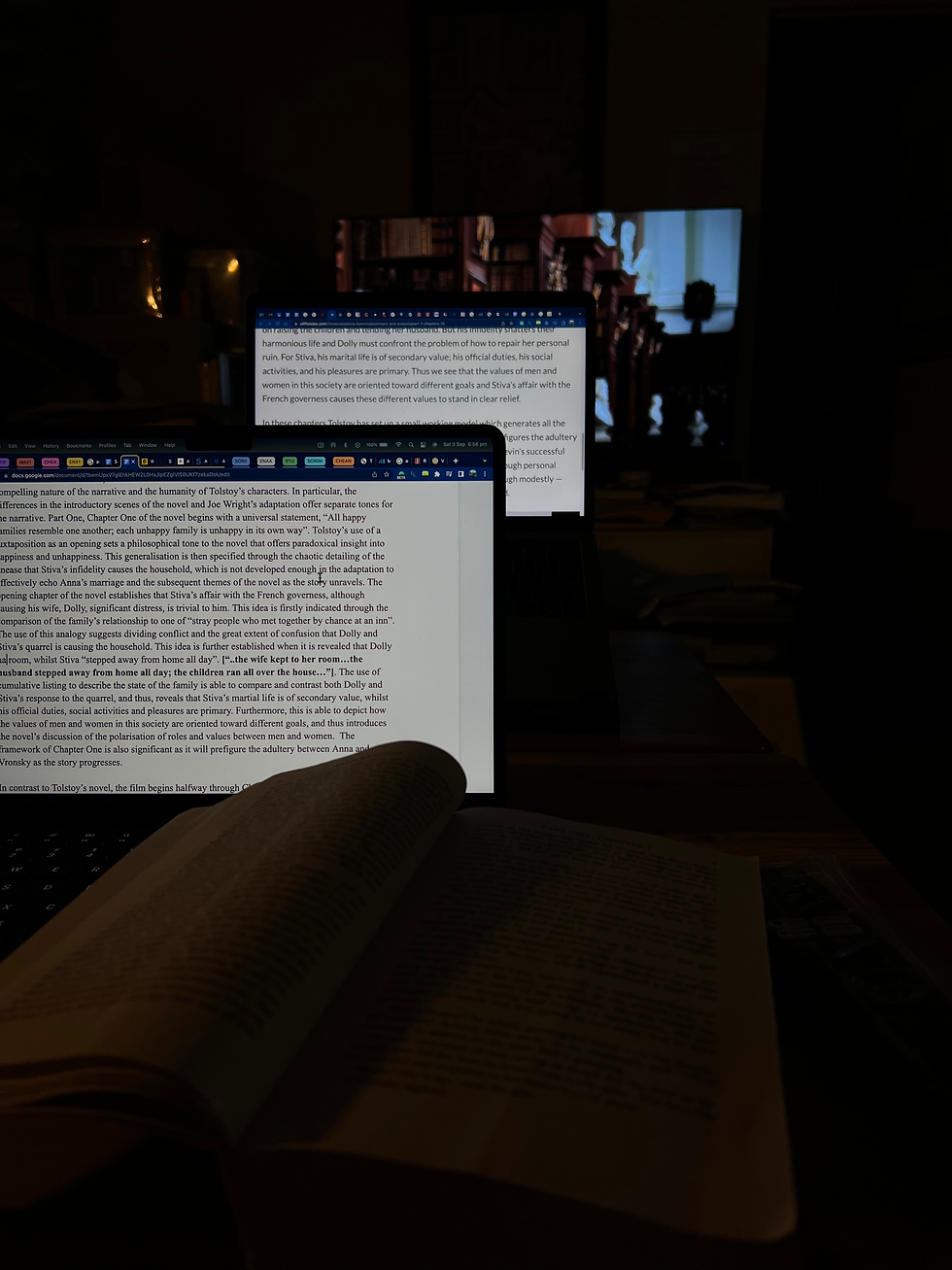
For 3 consecutive days, I sat at this desk for 10 hours at a time, working slavishly (mostly - it was a little difficult to not get sidetracked for five hours) on my final assignment of the year - the Independent Research Project for Preliminary English Extension. As a chronic masochist who is customary to delaying assignments and revision to the very brink of the deadline (by this, I mean quite literally starting an assignment a few hours before it’s due), it is certainly peculiar - completely unheard of- for me to spend ten hours on a project, let alone thirty. Nonetheless, this was the most awaited project of the year; my text of choice was locked in mind a term prior - the beloved Russian Classic, Anna Karenina (or Anna Karenin, depending on your persuasion, but I think sticking to established conventions is more suited for the reading of this novel) written by who is quite possibly the greatest author of all time, Leo Tolstoy.
For my project, I studied the novel comparatively with its grossly dissimilar 2012 English film adaptation, researching the crooks and nannies of the novel’s historical context and pointing at all the different ways the film is inferior (I respect Joe Wright a lot for his adaptation of Pride and Prejudice, but this one was just disappointing; I mean, above all, Keira Knightly again? Was this supposed to be Pride and Prejudice 2: Imperial Russia? I spent two hours trying to figure out why Elizabeth Bennet was feigning Anna). As some of you may already know, Anna Karenina is my ultimate favourite novel - one I’ve read 5 times back to front since I’ve secured its hard copy. Although the story spreads over more than 800 pages, depending on the translation, its unique complexity is not in Tolstoy’s use of language but rather its multifaceted nature - the perpetually interwoven threads of meticulously crafted parallel plots.
Alas, I acknowledge that this is not a book review (or an aggressive film review, per se, because I’d gladly add an extra thousand to my essay), so I’ll stop here and allow you, my dearest reader, to indulge in the enlightening experience of reading the novel for yourself - for whom will your empathy pour out to?
Although I’d gladly continue reflecting on my creative process and research, to assure you that I am not a veteran bore, I’d like to note that the focus of today’s post is not the technical contents of an imitation bible but rather what this has led to. Firstly, for some context, I am currently in the second week of my Preliminary final exams; my English Extension project was due in the first week, more specifically, the morning of my English Advanced exam and presented two hours after my Society and Culture exam on the Friday of the same week. Between these two events, I also sat an SOR II and Chemistry exam, a day apart from each other, and following all of these events, I sat my Mathematics Advanced exam on Monday morning. That was my second last exam - my final exam for this academic year is my Mathematics Extension 1 exam, which will take place on Friday of this week. Now, for a quick recap, I spent most of my time the week prior to my exam block working on my IRP for English Extension and any time in between procrastinating on it whenever I ran into writer’s block between paragraphs.
Essentially, to summarise, I willingly sabotaged (and still am, as you can tell) all six of my exams for my English Extension assignment.
“Because you want to do well?” You may ask. That’s the thing - it’s not because I’m academically competitive, per se; this project just happened to be a core interest, and working on it was relaxing in the sense that it put my mind off of my imminent demise, but ironic in the sense that it was dragging me closer. Dramatic irony at its absolute finest. Truly, I believe in Vivere senza rimpianti, but daring as it is, I really can’t say this was my wisest decision yet - especially considering that these exams contribute greatly to my overall grade. I’m devilishly close to witnessing my own downfall when my papers return to me next week - I barely revised for any of them.
Nevertheless, the focal point for me remains to be my IRP - would I rather achieve my usual average across my studies, or would I rather stay true to my desires? Wait- this sounds like...
Perhaps I’m not too different from Anna.
You’ll have to read to find out.